
Iroquois County Busted Mugshots
A mugshot is the photo police take when they book someone after an arrest. Several agencies in Iroquois County can make that arrest. The list includes the Sheriff's Office, the Watseka Police Department, the Clifton Police Department, and a county-contracted officer in Gilman. Once a person is in custody, the Iroquois County Jail in Watseka serves as the central holding facility. It sits at 550 South 10th Street. A 2025 Illinois Department of Corrections inspection calls it a 33-bed jail that houses county detainees and rarely holds people for outside jurisdictions.
No single file tells the whole story. The arresting agency keeps the initial report and its chronologically maintained arrest information. The jail may hold intake, custody, transfer, release, and photograph records. The court keeps the case, the hearings, and the final outcome. A person might be released on a notice to appear, transferred on an outside warrant, or moved to state or federal custody. Charges at booking can also be reduced, amended, dismissed, or never filed at all.
For official information, start with the Iroquois County Sheriff's Office page. It confirms jail and sheriff contacts. What it does not offer is a public current-custody table or any booking-photo search. The screenshot below shows the official contact surface, not a collection of faces.
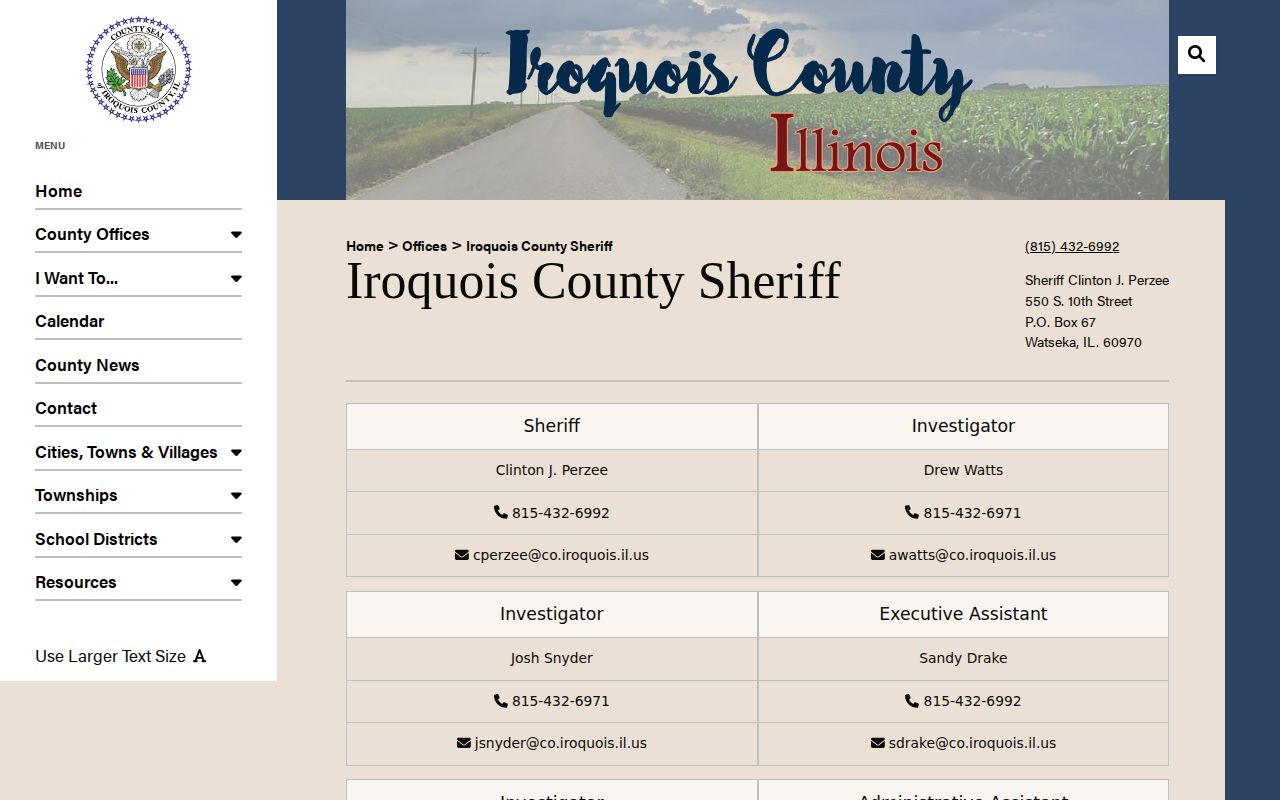
That distinction matters. An empty search result means only that the county web surface shows nothing. It does not prove that no internal jail record exists. Nor does it prove that no photograph was taken. A record can sit in an agency file without ever appearing online, and that gap cuts both ways for anyone digging through public sources.
These figures come from the inspection report and county board material. They are aggregate numbers. They describe how busy the system is. They are not a roster, and they reveal nothing about the identity of anyone arrested.
The Iroquois County Booking Record
Illinois FOIA section 2.15 gives chronologically maintained arrest information its own public-record category. The statute covers identifying details, the arrest facts, charges, the arresting agency, and custody events during incarceration. A photograph is listed only "when and if available." That phrase carries weight here. The official sheriff pages in Iroquois County promise neither a photo for each booking nor a web roster that displays one.
A good request names the person or a date range, the arresting agency, and the exact fields you want. Spell the name as the agency recorded it. Then compare the date, agency, age, and court case before treating two records as one event. Booking numbers show up often on vendor sites but are not exposed by the official county site. Report a bond amount or court date only when an official record supplies it.
| Field | What the record can show |
|---|---|
| Name and age | The identifying information recorded at arrest; age is tied to that event. |
| Address | An address may be listed but can be withheld or redacted; a full street address is not needed for ordinary verification. |
| Photo | A booking photograph only when and if one exists and is releasable. |
| Arrest date and time | The time of arrest, which may differ from booking time, article date, or court date. |
| Arrest location | The recorded location, subject to lawful redaction and privacy concerns. |
| Arresting agency | The sheriff, a city police department, Illinois State Police, or another agency named in the record. |
| Charges at arrest | The charges recorded at intake, not a conviction or final court result. |
| Custody event | Time received, discharge, transfer, notice to appear, or another release status when recorded. |
| Bond or bail | A release condition when the jail or court record provides it; no countywide schedule was located. |
| Facility and court | The holding facility, case number, hearing information, and later disposition when those records exist. |
A few terms come up again and again in jail records. "Booking" is the administrative intake that follows an arrest. An "arraignment" or initial appearance is a court event where the case and release conditions may be addressed. "Bond" is money or another condition tied to release. "Disposition" is the court's later result, such as a dismissal, plea, acquittal, or conviction. "Expungement" is a legal process that can remove or conceal qualifying records under Illinois law. None of these should be swapped with "released," which describes custody only.
- Notice to appear
- A direction to attend court without a continuing jail stay. It is not a dismissal.
- Transfer
- A move to another county, agency, or custody system. It is not a court disposition.
- Disposition
- The court outcome that follows the charge and hearings.
- Photo status
- Whether a photograph exists and can lawfully be released, not whether a third-party page displays an image.
Requesting an Iroquois County Busted Booking Photo
The county's formal access path is its FOIA request form. That form names Amanda Longfellow, Executive Assistant, as FOIA officer. It lists 1001 East Grant Street in Watseka, Illinois 60970, along with alongfellow@co.iroquois.il.us, 815-432-6955, and fax 815-432-5462. The form allows inspection or copies and asks you to describe the records. For a photo, write "booking photograph, when and if available" rather than asking the county to create a new image file.
Timing works like this. The county form promises an answer within seven working days. The current Illinois FOIA Act generally gives five business days for an ordinary written request, with one listed five-business-day extension allowed in qualifying circumstances. Section 2.15 adds its own arrest-information rule. Existing chronologically maintained arrest information should be furnished as soon as practical, and no later than 72 hours after the arrest. None of these deadlines promises an online post, a photograph, or the release of exempt material.
Fees come straight from the official form. Search and review cost nothing. The first 50 standard paper pages are free. After that, standard pages run 15 cents each, and other formats can carry actual reproduction costs. A narrow electronic request is usually easier to process than a demand for every file tied to a name.
- Identify the person, arrest date or date range, arresting agency, and whether the request concerns a city report, jail intake, or both.
- Ask for chronologically maintained arrest information, the booking or intake record, custody received and release or transfer times, and the booking photograph when and if available.
- Choose electronic delivery when available, state that exempt material may be redacted, and ask the county to identify the statute supporting each withholding.
- Keep the response, source date, and any court order together. Use the Circuit Clerk for the later case result, not the FOIA response as a substitute for disposition.
County records contact
Iroquois County FOIA Officer
Amanda Longfellow, Executive Assistant
1001 East Grant Street
Watseka, IL 60970
alongfellow@co.iroquois.il.us
815-432-6955 · Fax 815-432-5462
Watseka, Gilman, and Clifton each keep their own municipal records. A city police report belongs with that city or village records officer. A county jail intake or a county-held photo goes to the county instead. Either type of request can be denied or partly answered when juvenile confidentiality, an active investigation, safety, facility security, or another exemption applies.
Note: Ask for arrest date, booking date, release date, and article date separately because one event can create several different timestamps.
Illinois Mugshot Rules and Corrections
Illinois treats booking photographs as public records, but on its own terms. The Illinois FOIA Act, especially section 2.15, makes chronologically kept arrest data public and includes a photograph whenever one exists. That promise is narrow. Nothing in the law forces Iroquois County to run an online mugshot gallery, keep a permanent roster, or even snap a photo at every arrest. Other confidentiality rules still stand, among them the Juvenile Court Act. The same statute lets an agency redact or withhold material when another law applies, when disclosure could derail a proceeding, endanger someone, or undermine a correctional facility.
Section 2.15 also limits how police post booking photos on social media for lower-level offenses. Exceptions exist. Hunting a missing person, a fugitive, or a person of interest still permits posting. So a sheriff with no photo post is not signaling that no arrest occurred. The agency's own record, the court file, and the custody phone line each answer a different question.
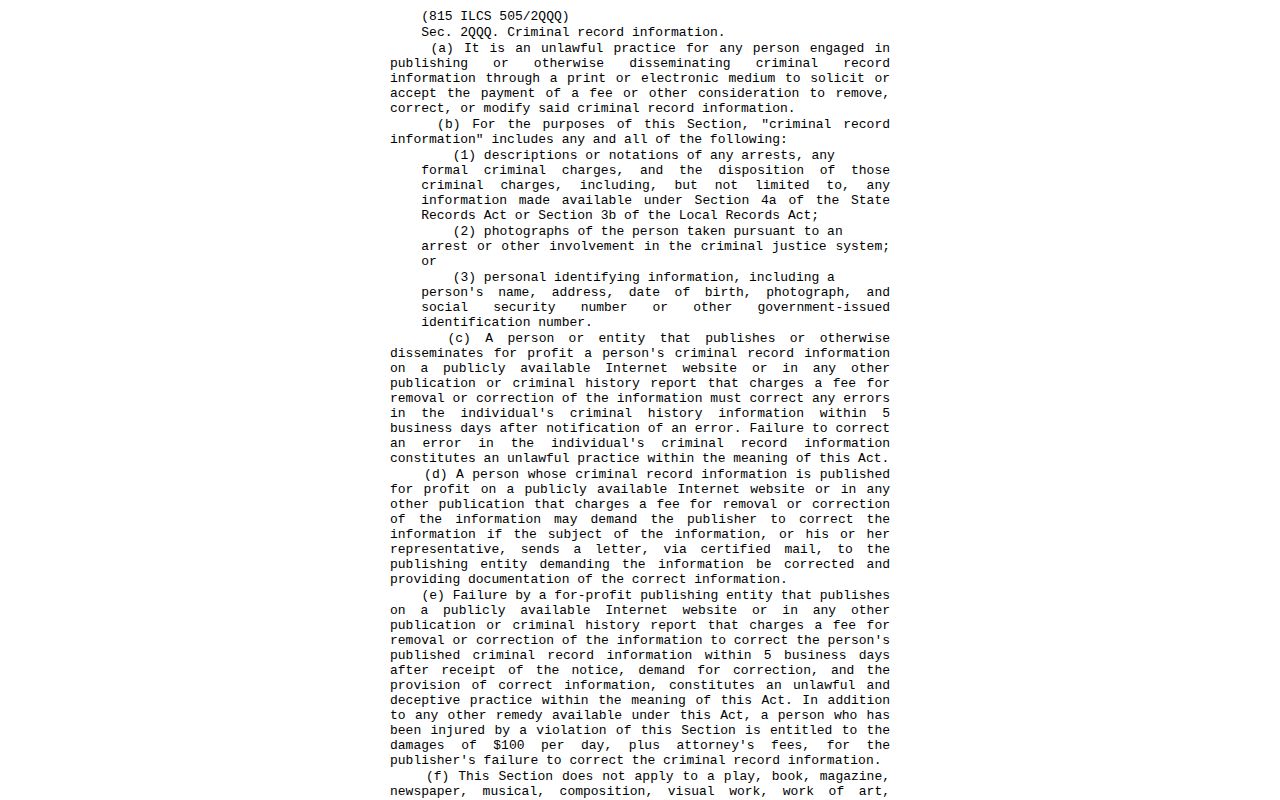
Corrections have their own statute. Under 815 ILCS 505/2QQQ, anyone publishing or spreading criminal-record information may not charge money to remove, fix, or alter covered material. The law builds in a free correction route for genuine errors and qualifying legal changes. It does not erase accurate arrest references. Nor does it hand an unofficial site the county's custodian duties.
The statute text answers correction questions best. Read it directly before relying on any summary.
When a private page gets something wrong, gather the proof first. Save the URL, the name as shown, the arrest date, and any document that demonstrates the mistake. Mugshots.com offers a free record-maintenance path for documented corrections and qualifying legal changes. RecentlyBooked and Busted Newspaper each describe free correction forms too. Neither showed a confirmed Iroquois County section. Arrests.org and Mugshots.zone had no verified local section either. A general policy never guarantees a local page exists.
Court-controlled changes run through the Illinois Courts expungement and sealing forms under the current 20 ILCS 2630/5.2 procedure. Eligibility turns on how the case ended, the offense category, waiting periods, any later records, and statutory exceptions. A dismissal travels a different path than a conviction. Refreshing a search engine is no substitute for a court order. An old copied page may demand its own separate correction request.
For the current status of any case, the court file is the place to look. Unofficial pages cannot answer custody or outcome questions.
Find Iroquois County Busted Mugshots and Arrests
No verified public name-search roster appears in the county's official pages. Searchers therefore need a verification ladder, not a single lookup. Begin with the agency that can actually answer the question at hand. A current-custody answer, an arrest report, a court outcome, and a state-prison profile are four different records. Confusing them wastes time.
- Check the sheriff's official page for the jail contact and call 815-432-6970 about present county custody. Staff can only confirm what they may lawfully disclose at that time.
- If the jail line cannot route the question, use Iroquois County 911 and dispatch at 815-432-4918 for non-emergency routing. Do not text 911 in this county.
- Check the arresting city or village records path. Watseka has a police page and municipal forms. Gilman uses county police protection under its current contract. Clifton has a village police department and a clerk/FOIA path.
- Use dated WIQI police-news reports as leads. Match the agency, date, town, alleged charge, and custody result before making a records request.
- Use the Circuit Clerk and Judici for the court stage, IDOC for a person in Illinois state custody, and FOIA for an existing jail record or photo when the other paths do not answer the question.
Custody status shifts fast. Someone booked an hour ago may sit in the county jail, while a released person drops off the current-custody answer even though the arrest record survives. A sentenced person may transfer to IDOC. An outside warrant can trigger a transfer or extradition, and someone released on a notice to appear may never leave a lasting jail entry at all. No web search can sort those outcomes apart. Warrant questions point to Iroquois County Most Wanted, and local media leads can be weighed against Iroquois County Crime News.
Where Iroquois County Busted Records Appear
Official channels earn the top spot. Each one answers a distinct record question. The county site offers contact and notice information, though no public roster or routine booking feed turned up there. News coverage and third-party pages can hand you a lead. Treat them as leads, never as a live county database.
| Channel | Photo? | Status | How to use it |
|---|---|---|---|
| Sheriff and jail | Not promised | Official | Call 815-432-6970 for present county custody and ask where a record request belongs. |
| County FOIA | When and if available | Official | Request dated arrest information, intake, custody events, and any releasable photo. |
| City police or village records | Source dependent | Official | Request the initial report, dispatch record, or agency-held image from the arresting department. |
| County news archive | No routine photo feed found | Official notices | Use Sheriff and Press Release filters for operational notices, not a complete booking list. |
| WIQI, Shaw Local, WGFA, WHPO | No consistent booking-photo practice observed | Secondary news | Use dated articles to identify agency, date, charge language, and release or transfer details. |
| IDOC Individual in Custody Search | Sometimes, current profile only | Official state | Search the state-prison slice, not a fresh county booking. |
| Judici and Circuit Clerk | Not a mugshot source | Official court | Check hearings, case entries, and disposition after identifying the right case. |
| Commercial third-party pages | Unreliable | Unofficial | Mugshots.com has historical Iroquois material; other named services had no verified local section. Treat all as stale or incomplete until the originating office confirms the record. |
The commercial tier includes Mugshots.com, RecentlyBooked, Arrests.org, Busted Newspaper, Mugshots.zone, and JailExchange. Their names surface constantly in search results. A page date or a cached image proves nothing about current custody, a county source, or any outcome. Do not rehost a photo. When accuracy matters, take the question to the official agency or the court.
One official surface is worth watching: the county-news archive. Its filters and its Sheriff/Press Release category show how operational updates get published, the 2022 phone-line outage being one example. Still, a date filter does not turn a news archive into a booking feed.
The county archive illustrates the difference between official notices and a current custody roster.
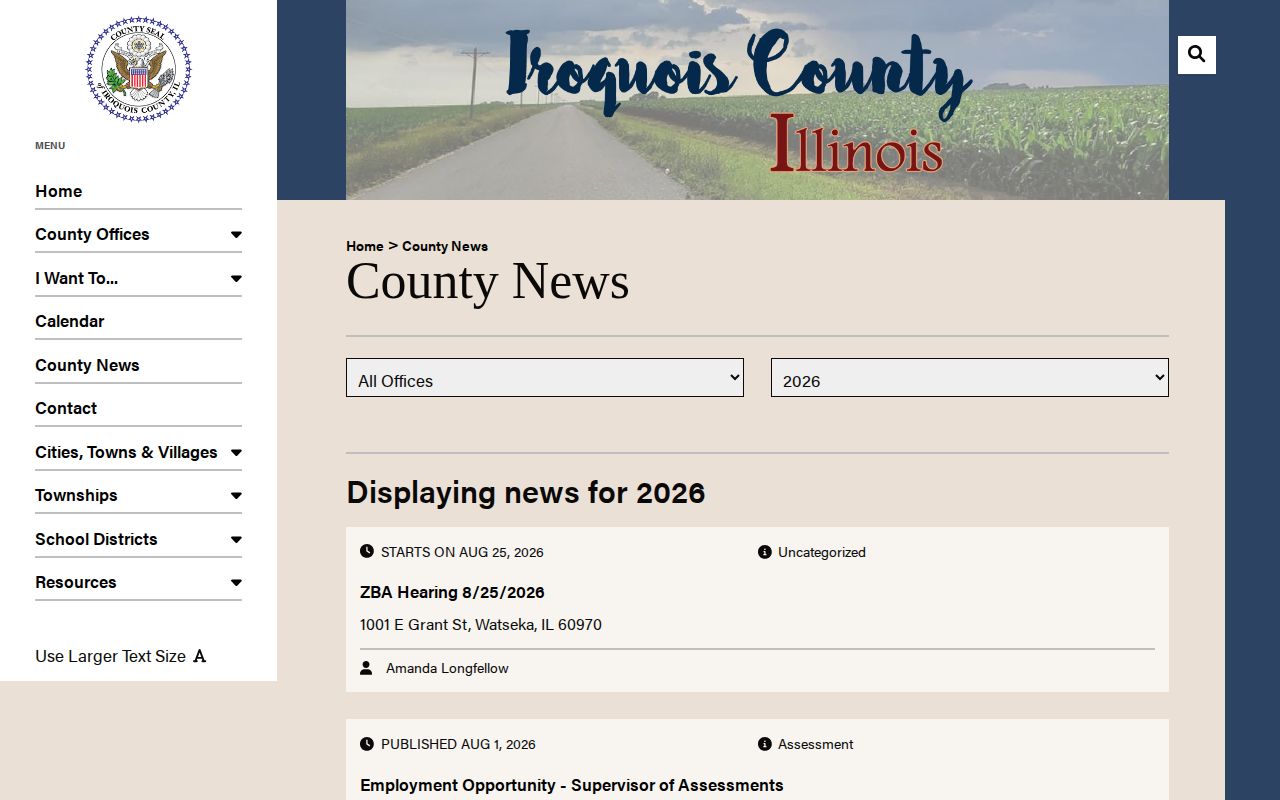
That hierarchy keeps old articles where they belong. A dated story can point you toward the arresting agency. It cannot update a court outcome. It cannot prove anyone still sits in the jail.
Busted and Booked in Iroquois County
The roster finding here is negative and specific. The sheriff's jail page lists a telephone number and nothing else of search value. No name field. No custody table, booking numbers, or photo thumbnails. No last-updated stamp, archive, or jail app either. Neither the county-news page nor the Judici court search fills that gap. The finding describes only the public website, not whatever internal system the jail runs behind the counter.
With no verified online roster, there are no official search fields to list. A records requester can still spell out the fields a search would need. That keeps the request narrow. It also makes any response far easier to check.
| Request field | Why it matters |
|---|---|
| Full name as recorded | Prevents a name-only match from merging different people. |
| Arrest and booking date range | Separates the arrest event from later jail intake or article dates. |
| Arresting agency | Routes a city report to the city and a jail intake to the county. |
| Custody status requested | States whether the question concerns current custody, release, or transfer. |
| Photo status | Asks whether a booking image exists and is releasable without assuming that one does. |
- Call the jail for a present-custody question. The answer can change after release or transport and is not a court disposition.
- Send a dated FOIA request for the fields above when a historical arrest, booking, release, or photo is needed.
- Use the Circuit Clerk for the case result and IDOC for state custody. Keep each result labeled by the agency that supplied it.
What if a roster search comes up empty? That does not mean nobody was booked. A person may have been released, transferred, or given a notice to appear. The paper trail may sit with a different agency. County inspection reports and board statistics only cover jail capacity, population, and total intakes. They cannot produce a name-by-name list. Iroquois County also has no booking app, inmate-search tool, or official jail social feed. A commercial directory's mobile page is a business product, not a county service. When in doubt, call the records custodian and ask directly.
Note: A jail telephone answer covers present custody only; it does not supply a historical archive or court outcome.
Busted Last Night? Iroquois County Booking Windows
No public Iroquois County feed lists arrests by a same-day, 48-hour, 72-hour, seven-day, or thirty-day window. The county-news archive does have date and category filters. Its Sheriff and Press Release items are administrative notices, though, not a running arrest log. So match any records request or phone call to the exact dates you care about. Nobody publishes a rolling booking list for this county.
| Window | Best available route | Limit |
|---|---|---|
| Same day or 24 hours | Jail telephone or arresting agency | Only current information the office may lawfully confirm; no photo promise. |
| 48 hours | Jail check plus a narrow agency request | Release, transfer, or notice to appear may already have changed custody. |
| Up to 72 hours | Section 2.15 arrest-information request | Timing concerns furnishing an existing record, not required online posting. |
| Seven days | County or city FOIA plus WIQI and county-news review | News publication may lag the arrest and is not a complete list. |
| Thirty days or older | FOIA, Judici, and relevant state or federal locators | No public county archive period was identified. |
WIQI is the best local lead for arrest news. Its dated Iroquois County Police News and Watseka Police News stories usually name the agency, the town, and the person's age. The charge or warrant description and the outcome come through too. That outcome might be a stay at the Iroquois County Jail, a notice to appear, a court hold, or a transfer. The articles are text-only; no regular booking-photo practice exists there. Monthly archives, such as June 2026, show news trickling out on no fixed schedule.
Be precise when you request a date range. Say which date you mean: the arrest, the booking, a release, a transfer, the article, or a court date. If no story turns up, say "no matching public article located" rather than "no arrest occurred." A weekend or holiday gap may reflect publication timing and nothing more.
Note: The article date, arrest date, booking date, and court date can all differ, so preserve each date in the record trail.
Illinois DOC Photos After Sentencing
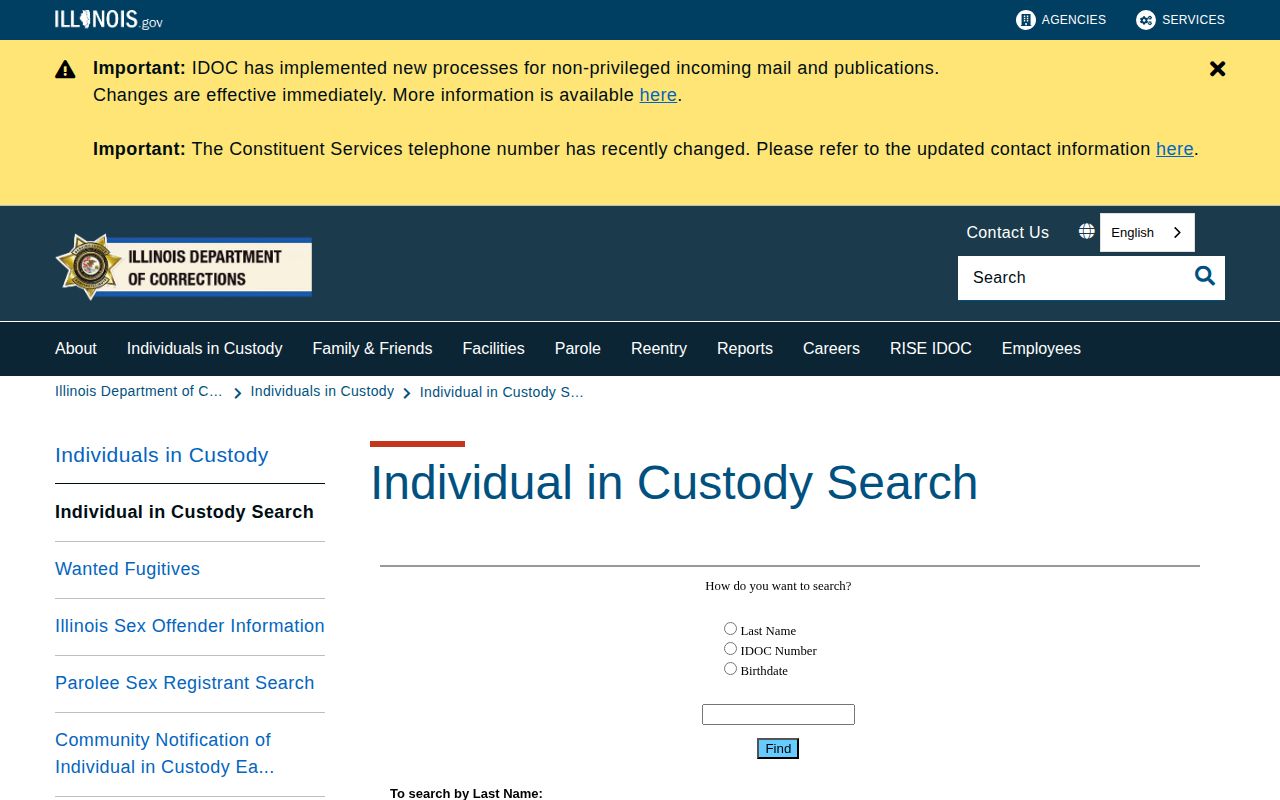
A case can move past the county jail and into state prison. At that point the Illinois Department of Corrections Individual in Custody Search becomes the tool that matters. It is not a county-jail roster. A last name, an IDOC number, or a birthdate will get you started. Older instructions allow partial last-name searches. Note that the IDOC number is a state identifier, not a county booking number.
Plenty of people will not show up here at all. Someone awaiting court in the Iroquois County Jail, released, held by another county, or in federal custody may never enter IDOC. A current state profile can show the name, IDOC number, institution, status, location, physical descriptors, and admission and release dates. Sentencing details appear too, and sometimes a photo. Per the IDOC media-request page, photos of current individuals are available through the search page. Photos of former individuals are confidential under Illinois law.
The state's photo directive covers admission shots, frontal and profile views, annual or appearance-change photos, and release or discharge images. Those rules apply to state custody only. They say nothing about whether an Iroquois County booking photo exists or can ever be pulled from IDOC.
Use the official state search once the custody question has moved beyond the county jail.
Illinois VINE sends custody and case-status alerts where the participating system supports the record. It is a notification service, not a photo source. Treat any alert as a tip worth confirming against the agency or court record before relying on it.
Busted, Released, or Transferred Records
A custody label tells you where a person is in the process. It does not tell you what a court decided. One arrest can pass through several systems. Each one generates its own paperwork. That is why an old news article, a jail phone call, and an IDOC profile can seem to disagree. They are simply records from different moments, not contradictions.
| Status | Likely source | What it does not prove |
|---|---|---|
| Just arrested or booked | Arresting agency and Iroquois County Jail | Guilt, a filed case, or a final charge. |
| Currently in county custody | Jail telephone, if staff may confirm it | That the person was booked on the date a news story appeared. |
| Released or notice to appear | Jail, arresting agency, or local report | Dismissal, acquittal, or any other court disposition. |
| Transferred or held for extradition | Jail, agency, or dated news report | A new Iroquois offense or conviction. |
| Sentenced to state custody | IDOC Individual in Custody Search | A fresh county booking or a local photograph. |
| Case resolved | Circuit Clerk and Judici | Present custody or the existence of a releasable photo. |
A released person drops off current-custody lookups fast. The booking record stays with the agency, though. A transferred person may show up in another county's locator or a federal one. Court records add another wrinkle: an outcome can change the charge while the arrest itself remains a fact. Different records capture different points in time.
After an Iroquois County Booking
The Iroquois County Circuit Clerk keeps the Circuit Court records and links the public to the Iroquois Judici search. Visit at 550 South 10th Street in Watseka. Hours run Monday through Friday, 8:30 a.m. to 4:30 p.m., and the phone is 815-432-6950. Search by full name first. Then confirm the county, the date, the case type, and other details. A shared name alone proves nothing.
The court path can stretch across several steps: a charging decision, an initial appearance or arraignment, bond or release conditions, further hearings, and a final disposition. A warrant pickup follows a different route than a fresh charge. A municipal citation may close with no county-jail stay at all. County code section 2-1 matters here. Under it, someone arrested or convicted of a municipal ordinance violation can be housed in the county jail only when the municipality holds an agreement with the county board. Treat that as a routing clue, not proof of any particular arrangement.
A busted booking in Iroquois County can generate several artifacts: local news coverage, a mugshot, and a jail roster entry. Each one reflects a moment in custody, nothing more.
Nothing on Judici? Call the Circuit Clerk. Ask about the public case record directly. Sealed matters, brand-new filings, and cases not yet posted online all call for a real inquiry rather than a guess. Release status and old police news items reveal nothing about how a case turned out. Treat both as background only.
Iroquois County Alerts and Apps
Iroquois County has no sheriff booking app. There's no inmate-search app or public jail social feed on the official website either. During a 2022 phone outage, the county told residents to watch its website and Facebook page for updates. Still, no stable direct Facebook link sits in the main navigation. The county-news archive is the dependable source. Its notices can be filtered by year and by category.
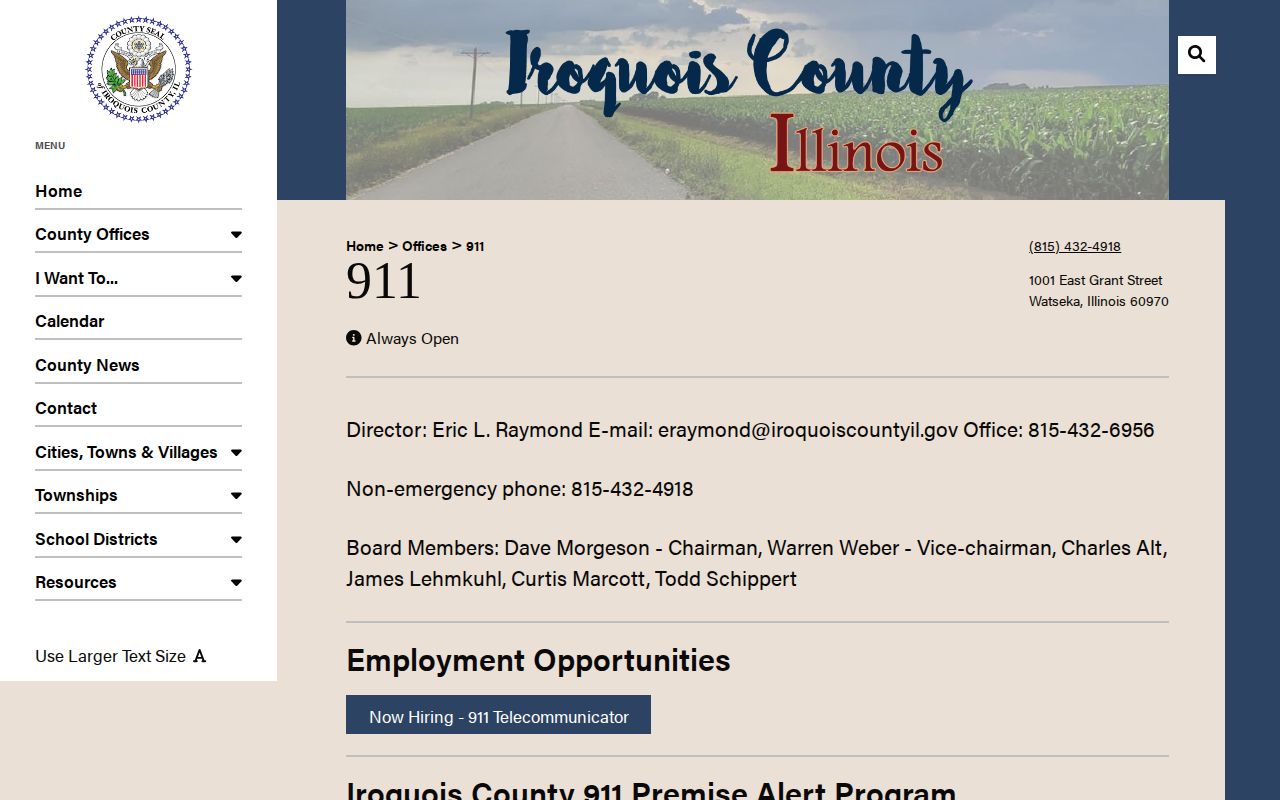
Need to reach someone fast? The county lists its 911 and dispatch center at 815-432-4918, and that line is staffed around the clock. Texting 911 does not work in the county, the official emergency page warns. Dispatch is not a records office and carries no booking feed. It is the right non-emergency call when you need to identify the proper agency or reach a public-safety contact.
The county emergency page supplies the non-emergency route and the text-to-911 warning.
Statewide, the notification path is Illinois VINE. Register by phone, text, or email and it can send custody or case-status alerts for participating systems. It builds no mugshot gallery, and it cannot stand in for a current check with the agency or the court. Treat it as one signal among several.
Federal Custody Is a Separate Search
A local arrest can end up in federal court, as a transfer, or under a hold. None of that turns the county jail into a federal record system. The Federal Bureau of Prisons locator covers federal inmates locked up from 1982 to the present. Search fields include name, register number, age, race, sex, release date, and location. It offers no public, county-style booking-photo search.
For immigration detention, use the ICE Online Detainee Locator. It works for people currently detained by ICE and anyone released from ICE custody within the previous 60 days. Exact-match entries are required. The U.S. Marshals Service houses some pretrial prisoners in county, state, and private facilities, and it generally does not release prisoner mugshots. Match any federal locator result to the agency, the date, and the court record before drawing conclusions. A name alone proves nothing about federal or immigration status.
Quick routing: for someone in county custody now, call the jail or dispatch. For a state-prison record, use IDOC. Federal or immigration questions start with the right federal locator, then verification against the local court or agency record. Each path covers a different kind of custody.
Busted Mugshots by Iroquois County City
City pages here follow the county's 2020 Census population order. Watseka stays locked in first as the county seat. None of the three municipal websites carries a dedicated arrest log, booking-photo search, or public roster. A custodial arrest made by a city normally routes to the county jail anyway. Confirm the destination with the arresting agency before you search elsewhere.
- Watseka Busted Mugshots explains the city's police department, I-COM dispatch, municipal FOIA path, and county-jail handoff. Watseka is the county seat and the largest selected place.
- Gilman Busted Mugshots centers on the city's county police-protection contract since 2021 and the City Clerk's FOIA route.
- Clifton Busted Mugshots covers the village police department, sheriff relay, village FOIA officer, and the absence of a separate Clifton jail.
Onarga comes close in population. Still, it does not qualify as one of the three required city pages under the 2020 population rule. Remember that a city name in a news story marks a location, not necessarily the agency that created the booking record. Start with the city page for the local records path. Then move to the county and court sources for custody and disposition.
Iroquois County Records and Archives
No public source says how long the sheriff keeps booking sheets. The same goes for arrest logs, booking photographs, or an electronic roster export. When an old image is missing online, the reasons vary. Maybe no web copy was ever posted. A page may have changed, or a record was lawfully destroyed under an approved schedule, or another agency holds it. Anyone quoting an exact retention period for these records is guessing.
Illinois requires local agencies to apply the approved records authority before disposing of anything. For a real answer, ask the sheriff or the county FOIA officer. Request the series number, the retention period, and any disposal certificate covering jail booking records, arrest logs, photographs, and roster exports. The Iroquois IRAD holdings turned up no transferred sheriff booking-photo series and no current jail-roster archive.
Work the chain in order. Start with the sheriff or jail records custodian, then the county FOIA officer, then the Illinois State Archives or Local Records Commission, and IRAD if a historical series may have moved. A county board statistic, a newspaper clip, or a third-party entry is not a custody ledger.
Why Iroquois County Photo Access Is Conditional
Illinois law makes the record path specific but limited. A photo can exist without ever being posted online. A booking can exist without a roster result. And a public record can still be walled off by juvenile, investigative, safety, or facility-security rules. So "when and if available" fits Iroquois County far better than any promise that every arrest comes with a public mugshot.
Corrections work the same way. A court order, a clerk disposition, an agency correction, or proof of mistaken identity gives a publisher something concrete to review. Private copies can linger after a government record changes, and search engines can keep serving an old snippet long after the source page updates. Preserve the source date and direct your correction request to the entity that controls the copy. Never send sensitive documents to an unverified recipient.
Illinois Courts provides the current forms and instructions for sealing or expungement.
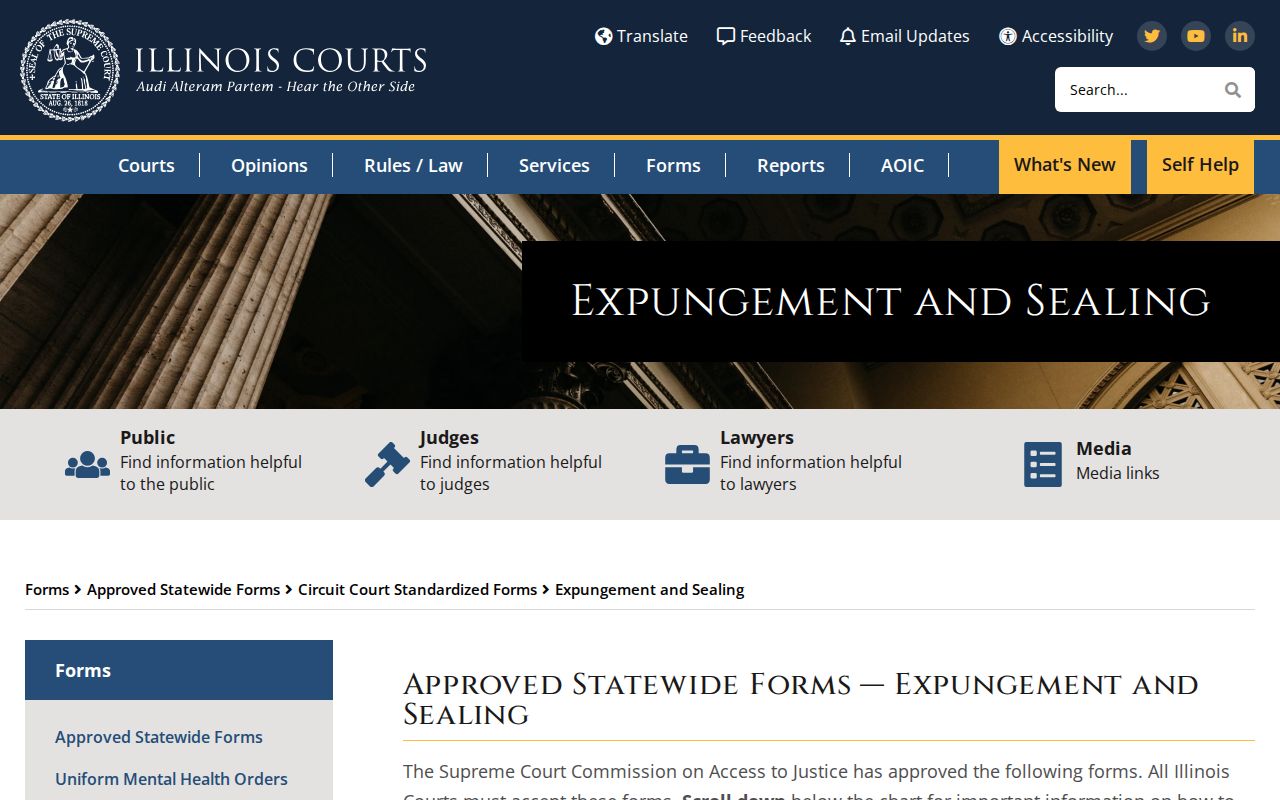
Eligibility for photo removal depends on how a case ended. A dismissal, an acquittal, a no-charge result, or a qualifying supervision outcome each carries its own legal path. The governing form and statute set the rules. Once the court issues an order, copies go to three places: the court itself, the arresting agency, and any private publisher still showing a page the order covers. One caution applies here. Clearing a search result does not erase the underlying record, and expungement requires the formal order to take full effect.
Public Record Search
Sponsored Results